Foreløbige noter
Kun en ekspert kan med sikkerhed
identificere de enkelte vulkanske lag i klinterne, noget jeg ikke er!.
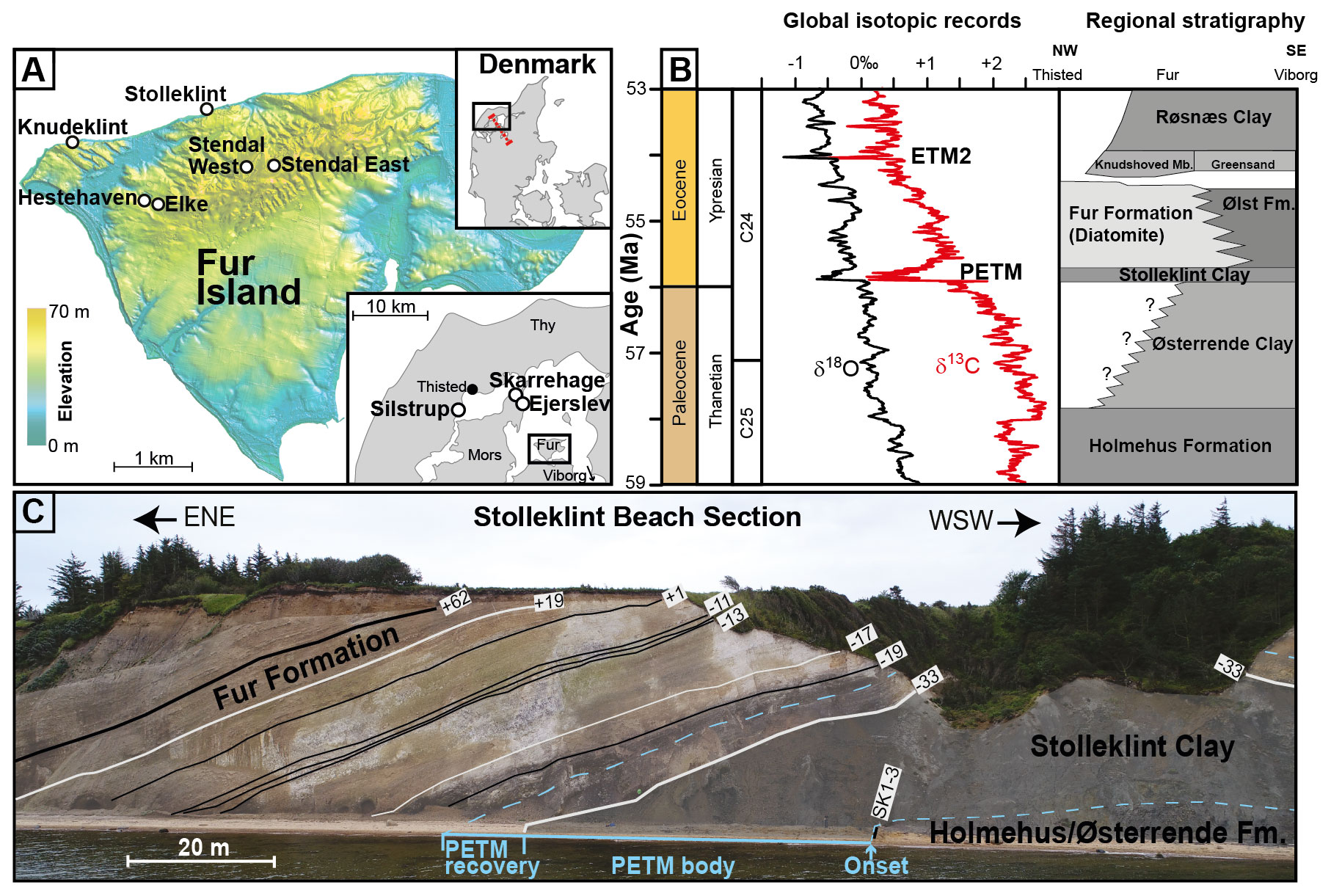
Men det kan give mening at det næsten 1 meter tykke grå askelag som ses
på billedet under "Forberedende øvelser" er askelag -33. Dels er det
gråt og vældig tykt, og ikke sort, og ser man nøje på illustrationen
fra Ella Stokke og hennes kollegaers artikel er askelag -33 overlejret
af mørk sediment til venstre på billedet, men ikke til højre (det
anføres i artiklen at "Black lines denote key basaltic ash layers,
while white lines mark the silicic Ashes −33, −17, and +19"). Det
gyldne sediment som overlejrer det grå askelag på billedet under
"Forberedende øvelser" kan derfor tilsvare den mørke overlejring til
venstre på Stokkes billede, eller for så vidt også sedimentet over
askelag -33 til højre på den fine illustration. En anden ting som
understøtter at der er tale om askelag -33 er at det sorte sediment
brugt i de aktuelle eksperimenter udmærket kan hidrøre fra Stolleklint
ler som i følge nedenfor anførte konversation med "DeepSeek 4 Pro" er kendt som en sulfid-rig ler som ved opslemning i oxygeneret vand netop forårsager en pH omkring 2 i opslemningen.
Ved eksperimentet "Run1" virkede supernatanten i havvandsdelen lidt mere farvemættet og mer orangebrun end delen med demineraliseret vand, noget jeg noterede men desværre ikke la vækt på og derfor ikke tog noget foto. Nedenfor derfor også et bægerglas lavet nu i eftertid med typisk supernatant fra ikke helt frisk sediment i havvand efter en time, lidt mindre dyp i farve og uden det orange skær fra "Run1".

Per:when a small sample of the black-blue clay from below the thick grey band of volcanic ash is
suspended in demineralised water the supernatant will be sour with a pH around 2. What are your
thoughts on this?
DeepSeek:
That's a lovely, almost textbook result — and it tells you a lot about that clay. My
thoughts, in order:
What's happening chemically: the black-blue clay is behaving like a pyrite-bearing, organic-
rich reduced marine clay — exactly what the Ølst Formation / Stolle Klint Clay beneath the
Fur Formation is. The black colour is organic matter plus finely dispersed pyrite (FeS₂),
formed by bacterial sulfate reduction in quiet, anoxic seafloor mud. When you suspend it in
demineralised water (oxygenated), pyrite oxidises and generates sulfuric acid:
• FeS₂ + 7/2 O₂ + H₂O → Fe²⁺ + 2 SO₄²⁻ + 2 H⁺
• then Fe²⁺ oxidises to Fe³⁺, which hydrolyses: Fe³⁺ + 3 H₂O → Fe(OH)₃ + 3 H⁺
The net effect: pyrite + oxygen + water → sulfuric acid + iron (hydr)oxides. A pH of 2–3 is
exactly the range this process produces — it's the classic acid sulfate soil / acid rock
drainage reaction.
Why demineralised water makes it so obvious: it has essentially no buffering capacity. The
same clay in hard tap water or seawater would show much less acid, because
bicarbonate/carbonate would neutralise the first acid produced.
Is it consistent with the local geology? Very much so. The Ølst Formation / Stolle Klint Clay
in Denmark is well known as a sulfide-rich clay that does precisely this: when drained or
excavated, oxidation produces acid runoff with pH down to ~2, iron staining, and efflorescent
sulfate salts (gypsum, jarosite). So your sample is behaving like the type material. The
"blue" tint is probably just the reduced-iron/organic colour of the unweathered clay —
possibly with a bit of glauconite or reduced Fe minerals.
Two predictions you can check in the kitchen/field lab:
1. The suspension should slowly turn brownish/orange as Fe²⁺ oxidises and Fe(OH)₃
precipitates.
2. Adding a few drops of hydrogen peroxide (H₂O₂) will accelerate the oxidation — the pH
should drop further, and you'll smell nothing in particular, but the acid/Fe chemistry
confirms it.
One interpretive caveat worth keeping: this acidity is a weathering/oxidation phenomenon. The
fresh, anoxic clay in place is near-neutral; the acid only develops once the pyrite meets
oxygen — in your suspension, in a spoil heap, or in an excavation. So the observation is a
nice demonstration of how an anoxic seabed mud from ~55 Ma becomes an acid source when we
expose it to today's atmosphere.
Per: Great answer, thank you - The suspension in fact turn brownish/orange after an hour or
two!. Using "drinking water quality test sticks" also manganese is present in the suspension. How
will this influence the rate of oxidation of the ferrous ions in the suspension, and on the
chemistry in the suspension in general?
DeepSeek: Great that it matched the prediction — that browning is your Fe(III) oxyhydroxide forming.
Now, manganese changes the picture in an interesting but slightly counterintuitive way.
Short answer: the dissolved Mn²⁺ your sticks are seeing is mostly a spectator, not the driver
of Fe²⁺ oxidation. At pH ~2, the homogeneous oxidation of Fe²⁺ by dissolved O₂ is
intrinsically slow (rate ∝ [OH⁻]² — at pH 2 it's sluggish, half-lives of days), and dissolved
Mn²⁺ does little to change that. So the Mn is best read as diagnostic: the acid attack has
released Mn from the clay (Mn carbonates, Mn substituted in clay minerals/pyrite, or reduced
Mn-oxide rims).
The fast browning you saw therefore means the oxidation is surface-catalysed, not
homogeneous. The catalysts are:
1. Fe(III) oxyhydroxide itself (autocatalytic) — fresh ferrihydrite surfaces adsorb Fe²⁺ and
O₂ and accelerate electron transfer. This is the classic self-accelerating pathway and is
probably your main one.
2. Mn(III/IV) oxides, if present — this is where Mn can genuinely speed things up. Manganese
oxide is a powerful oxidant for Fe²⁺ even at low pH:
• MnO₂ + 2 Fe²⁺ + 4 H⁺ → Mn²⁺ + 2 Fe³⁺ + 2 H₂O
Each MnO₂ particle oxidises two Fe²⁺ instantly and releases Mn²⁺ — which is exactly the Mn
your test strips detect. So if the clay carries any residual or re-forming Mn-oxide, it
both accelerates the Fe²⁺ oxidation and puts Mn²⁺ into solution. (In a black, reduced clay
most Mn is already Mn(II), so the Mn²⁺ mostly just dissolves; but any oxidised skin on the
sample does the redox work.)
3. Possibly microbes — acid-tolerant iron oxidisers like Acidithiobacillus ferrooxidans
thrive at pH ~2 and oxidise Fe²⁺ fast. If the clay is natural and not sterilised, biology
is a real candidate.
General chemistry of the suspension — the useful part:
• Fe and Mn fractionate. At pH ~2, Fe³⁺ hydrolyses and precipitates early as the brownish-
orange ochre, while Mn²⁺ stays dissolved — Mn(OH)₂ needs much higher pH, and Mn²⁺ → MnO₂
oxidation is kinetically dead at low pH. So your suspension will end up with the iron in
the solid phase and most of the manganese in the supernatant. That's the classic acid-
drainage sequence: ochre first, black Mn-oxide coatings only later when the water is
neutralised.
• The fresh Fe(OH)₃ scavenges Mn²⁺. Ferrihydrite has a huge surface area and
adsorbs/coprecipitates Mn²⁺ (and other trace metals), so a fraction of the Mn rides down
with the ochre — the fact that your sticks still show Mn in the supernatant means there's
more Mn than the sorption capacity can hold.
• Predictable experiment: if you slowly raise the pH toward 7–8 while aerating, the remaining
Mn²⁺ will oxidise and precipitate as dark brown-black MnO₂ (often as a coating on the
ochre). That Mn redox "crossover" pH is a nice demonstration of the Fe/Mn separation.
• Side chemistry: in such an acidic, Fe(II)-rich soup, trace H₂O₂ (atmospheric or microbial)
can drive Fenton-type reactions (Fe²⁺ + H₂O₂ → Fe³⁺ + OH· + OH⁻), and Mn²⁺ participates in
analogous Fenton-like cycles. These generate hydroxyl radicals that chew up dissolved
organics — which is part of why acid sulfate waters end up so altered chemically.
Geological tie-in: this is exactly the signature of weathering a pyrite-rich reduced marine
clay like the Ølst/Stolle Klint Clay — acid release, Fe ochre precipitating first, Mn staying
mobile, and in the field, reddish iron staining with black manganese crusts appearing
wherever the drainage is neutralised. Your test-stick result is, in miniature, the whole acid
sulfate weathering story.
Per:I did the experiment by adding demineralised water to one sample and seawater to another
sample where there is no significant difference in pH in the two experiments, and the
orange/brown color of the supernatant in the seawater experiment is more distinct. What are
your thoughts about this?
DeepSeek:
That's a really informative result — and it actually corrects the simple expectation I gave
earlier (that seawater would buffer the acid away). What you observed means the clay's acid-
generating capacity is so large that it simply overwhelms the seawater's alkalinity, while
the seawater does something else entirely: it makes the iron ochre form faster and flocculate
better. Let me unpack both observations.
Why the pH came out the same
The buffer argument is quantitatively weak once you put numbers on it:
• Pyrite oxidation gives ~4 mol H⁺ per mol FeS₂ — i.e. ~33 mmol H⁺ per gram of pyrite
oxidised.
• Seawater's total alkalinity is only ~2.3 mmol per litre.
So even a modest pinch of pyrite in a small suspension can out-acid a whole bottle of
seawater. In both of your jars, the final pH is set not by the starting water but by the
pyrite–Fe chemistry (Fe³⁺ hydrolysis equilibrium), so both land around pH ~2–3. The seawater
did neutralise some acid early on — its HCO₃⁻/CO₃²⁻ gets converted to CO₂ (you may even have
seen slight effervescence at the start) — but once that alkalinity is spent, the pH collapses
to the same value as the demineralised-water jar. That "lag phase" before the collapse is
actually the key to your second observation.
Why the seawater suspension is more distinctly orange/brown
Three reinforcing effects:
1. A high-pH window of fast oxidation. Seawater starts at pH ~8.2 and stays buffered until
its alkalinity is consumed. Homogeneous Fe²⁺ oxidation is roughly proportional to [OH⁻]²,
so while the seawater jar was still near-neutral, Fe²⁺ was oxidising orders of magnitude
faster than in the demineralised-water jar (which was acidic from the start). The result:
more Fe(III) formed overall in the seawater jar before both settled at the same final pH —
hence more ochre.
2. Salinity flocculates the colloid. Ferrihydrite in demineralised water stays as a fine,
electrostatically stabilised colloid that can look faint and settle slowly. Seawater's
high ionic strength — especially Ca²⁺ and Mg²⁺ — compresses the double layer and
coagulates those particles into larger, visible orange-brown flocs. Same amount of iron,
but far more optically conspicuous.
3. Chloride/carbonate mineralogy. In chloride-rich water, Fe(III) tends to precipitate as
akaganeite-type phases, and carbonate surfaces provide good nucleation sites; both promote
visible solid formation rather than a stable colloid.
The decisive control experiment
If you want to prove which effect dominates, do the reverse:
• Take a spoonful of the demineralised-water suspension and add a pinch of table salt (or a
splash of seawater). If it quickly turns distinctly orange/brown and flocculates, that's
the coagulation effect — same iron, new visibility.
• Take the seawater suspension and dilute it 10× with fresh seawater. Now the alkalinity
should be able to hold the pH up, and the colour will be much less intense.
Geological reading
This is exactly how these clays behave in nature at the coast: the Ølst/Stolle Klint-type
pyrite clay has far more acid potential than any natural water can buffer, so wherever it's
excavated or drained it acidifies regardless of whether the water is fresh or marine. And
your seawater jar is a miniature estuary — acidic, iron-rich water hitting saline water is
precisely where ochre flocculates and drops out as the classic orange-brown precipitates you
see in acid sulfate drainage plumes.
One small correction to my earlier wording, by the way: I said the clay in seawater would
show "much less acid." Your experiment shows the more useful general statement — seawater can
delay and partially buffer the acid, but it cannot prevent it when pyrite is abundant; what
it does do is dramatically change the fate of the iron.
Per: You mentioned earlier in our conversation that "at pH ~2, the homogeneous oxidation of Fe²⁺
by dissolved O₂ is intrinsically slow (rate ∝ [OH⁻]² — at pH 2 it's sluggish, half-lives of days)".
Could you briefly elaborate on what the phrase "rate ∝ [OH⁻]²" mean?
DeepSeek: Sure — it's just a compact way of writing how the reaction speed depends on hydroxide
concentration.
What the symbols mean
• "rate" = how fast Fe²⁺ is oxidised (e.g., how much Fe³⁺ forms per second, or how quickly
Fe²⁺ disappears).
• "[OH⁻]" = the concentration of hydroxide ions in the water, usually in mol/L.
• "∝" means "is proportional to" — i.e., rate = k · [OH⁻]², where k is a constant that
depends on things like temperature and O₂.
• The "²" means the hydroxide concentration appears squared: [OH⁻] × [OH⁻].
So the full statement is:
▎ rate = k · [OH⁻]² · [Fe²⁺] · [O₂]
In plain words: double the OH⁻ concentration and the oxidation rate goes up by 2² = 4 times;
increase OH⁻ tenfold and the rate goes up 100-fold.
Why this makes pH the dominant control
[OH⁻] is not an independent knob — it's set by pH through the water equilibrium ([OH⁻] =
10^(pH−14) in mol/L at 25 °C). So:
• At pH 8 (seawater): [OH⁻] = 10⁻⁶ → rate factor (10⁻⁶)² = 10⁻¹²
• At pH 2 (your acid suspension): [OH⁻] = 10⁻¹² → rate factor (10⁻¹²)² = 10⁻²⁴
That's a 12-orders-of-magnitude difference in the hydroxide-dependent part of the rate — a
factor of a trillion. That's why going from pH 8 to pH 2 doesn't just slow Fe²⁺ oxidation a
bit; it essentially switches the homogeneous reaction off, leaving days-long half-lives
instead of seconds-to-minutes.
The conceptual picture
The rate law reflects the mechanism: two OH⁻ groups help strip the protons (and form the
hydroxide bridges) needed to oxidise Fe²⁺. The less OH⁻ there is, the rarer those encounters
become — and because the dependence is squared, the penalty for lowering pH is
disproportionately severe.
And that's also why your fast browning at pH ~2 was chemically interesting: the homogeneous
(bulk-solution) pathway can't explain it — it must be happening via a faster route (surfaces,
Mn oxides, or microbes), which is what we discussed.
Ved eksperimentet "Run1" virkede supernatanten i havvandsdelen lidt mere farvemættet og mer orangebrun end delen med demineraliseret vand, noget jeg noterede men desværre ikke la vækt på og derfor ikke tog noget foto. Nedenfor derfor også et bægerglas lavet nu i eftertid med typisk supernatant fra ikke helt frisk sediment i havvand efter en time, lidt mindre dyp i farve og uden det orange skær fra "Run1".
Per:when a small sample of the black-blue clay from below the thick grey band of volcanic ash is
suspended in demineralised water the supernatant will be sour with a pH around 2. What are your
thoughts on this?
DeepSeek:
That's a lovely, almost textbook result — and it tells you a lot about that clay. My
thoughts, in order:
What's happening chemically: the black-blue clay is behaving like a pyrite-bearing, organic-
rich reduced marine clay — exactly what the Ølst Formation / Stolle Klint Clay beneath the
Fur Formation is. The black colour is organic matter plus finely dispersed pyrite (FeS₂),
formed by bacterial sulfate reduction in quiet, anoxic seafloor mud. When you suspend it in
demineralised water (oxygenated), pyrite oxidises and generates sulfuric acid:
• FeS₂ + 7/2 O₂ + H₂O → Fe²⁺ + 2 SO₄²⁻ + 2 H⁺
• then Fe²⁺ oxidises to Fe³⁺, which hydrolyses: Fe³⁺ + 3 H₂O → Fe(OH)₃ + 3 H⁺
The net effect: pyrite + oxygen + water → sulfuric acid + iron (hydr)oxides. A pH of 2–3 is
exactly the range this process produces — it's the classic acid sulfate soil / acid rock
drainage reaction.
Why demineralised water makes it so obvious: it has essentially no buffering capacity. The
same clay in hard tap water or seawater would show much less acid, because
bicarbonate/carbonate would neutralise the first acid produced.
Is it consistent with the local geology? Very much so. The Ølst Formation / Stolle Klint Clay
in Denmark is well known as a sulfide-rich clay that does precisely this: when drained or
excavated, oxidation produces acid runoff with pH down to ~2, iron staining, and efflorescent
sulfate salts (gypsum, jarosite). So your sample is behaving like the type material. The
"blue" tint is probably just the reduced-iron/organic colour of the unweathered clay —
possibly with a bit of glauconite or reduced Fe minerals.
Two predictions you can check in the kitchen/field lab:
1. The suspension should slowly turn brownish/orange as Fe²⁺ oxidises and Fe(OH)₃
precipitates.
2. Adding a few drops of hydrogen peroxide (H₂O₂) will accelerate the oxidation — the pH
should drop further, and you'll smell nothing in particular, but the acid/Fe chemistry
confirms it.
One interpretive caveat worth keeping: this acidity is a weathering/oxidation phenomenon. The
fresh, anoxic clay in place is near-neutral; the acid only develops once the pyrite meets
oxygen — in your suspension, in a spoil heap, or in an excavation. So the observation is a
nice demonstration of how an anoxic seabed mud from ~55 Ma becomes an acid source when we
expose it to today's atmosphere.
Per: Great answer, thank you - The suspension in fact turn brownish/orange after an hour or
two!. Using "drinking water quality test sticks" also manganese is present in the suspension. How
will this influence the rate of oxidation of the ferrous ions in the suspension, and on the
chemistry in the suspension in general?
DeepSeek: Great that it matched the prediction — that browning is your Fe(III) oxyhydroxide forming.
Now, manganese changes the picture in an interesting but slightly counterintuitive way.
Short answer: the dissolved Mn²⁺ your sticks are seeing is mostly a spectator, not the driver
of Fe²⁺ oxidation. At pH ~2, the homogeneous oxidation of Fe²⁺ by dissolved O₂ is
intrinsically slow (rate ∝ [OH⁻]² — at pH 2 it's sluggish, half-lives of days), and dissolved
Mn²⁺ does little to change that. So the Mn is best read as diagnostic: the acid attack has
released Mn from the clay (Mn carbonates, Mn substituted in clay minerals/pyrite, or reduced
Mn-oxide rims).
The fast browning you saw therefore means the oxidation is surface-catalysed, not
homogeneous. The catalysts are:
1. Fe(III) oxyhydroxide itself (autocatalytic) — fresh ferrihydrite surfaces adsorb Fe²⁺ and
O₂ and accelerate electron transfer. This is the classic self-accelerating pathway and is
probably your main one.
2. Mn(III/IV) oxides, if present — this is where Mn can genuinely speed things up. Manganese
oxide is a powerful oxidant for Fe²⁺ even at low pH:
• MnO₂ + 2 Fe²⁺ + 4 H⁺ → Mn²⁺ + 2 Fe³⁺ + 2 H₂O
Each MnO₂ particle oxidises two Fe²⁺ instantly and releases Mn²⁺ — which is exactly the Mn
your test strips detect. So if the clay carries any residual or re-forming Mn-oxide, it
both accelerates the Fe²⁺ oxidation and puts Mn²⁺ into solution. (In a black, reduced clay
most Mn is already Mn(II), so the Mn²⁺ mostly just dissolves; but any oxidised skin on the
sample does the redox work.)
3. Possibly microbes — acid-tolerant iron oxidisers like Acidithiobacillus ferrooxidans
thrive at pH ~2 and oxidise Fe²⁺ fast. If the clay is natural and not sterilised, biology
is a real candidate.
General chemistry of the suspension — the useful part:
• Fe and Mn fractionate. At pH ~2, Fe³⁺ hydrolyses and precipitates early as the brownish-
orange ochre, while Mn²⁺ stays dissolved — Mn(OH)₂ needs much higher pH, and Mn²⁺ → MnO₂
oxidation is kinetically dead at low pH. So your suspension will end up with the iron in
the solid phase and most of the manganese in the supernatant. That's the classic acid-
drainage sequence: ochre first, black Mn-oxide coatings only later when the water is
neutralised.
• The fresh Fe(OH)₃ scavenges Mn²⁺. Ferrihydrite has a huge surface area and
adsorbs/coprecipitates Mn²⁺ (and other trace metals), so a fraction of the Mn rides down
with the ochre — the fact that your sticks still show Mn in the supernatant means there's
more Mn than the sorption capacity can hold.
• Predictable experiment: if you slowly raise the pH toward 7–8 while aerating, the remaining
Mn²⁺ will oxidise and precipitate as dark brown-black MnO₂ (often as a coating on the
ochre). That Mn redox "crossover" pH is a nice demonstration of the Fe/Mn separation.
• Side chemistry: in such an acidic, Fe(II)-rich soup, trace H₂O₂ (atmospheric or microbial)
can drive Fenton-type reactions (Fe²⁺ + H₂O₂ → Fe³⁺ + OH· + OH⁻), and Mn²⁺ participates in
analogous Fenton-like cycles. These generate hydroxyl radicals that chew up dissolved
organics — which is part of why acid sulfate waters end up so altered chemically.
Geological tie-in: this is exactly the signature of weathering a pyrite-rich reduced marine
clay like the Ølst/Stolle Klint Clay — acid release, Fe ochre precipitating first, Mn staying
mobile, and in the field, reddish iron staining with black manganese crusts appearing
wherever the drainage is neutralised. Your test-stick result is, in miniature, the whole acid
sulfate weathering story.
Per:I did the experiment by adding demineralised water to one sample and seawater to another
sample where there is no significant difference in pH in the two experiments, and the
orange/brown color of the supernatant in the seawater experiment is more distinct. What are
your thoughts about this?
DeepSeek:
That's a really informative result — and it actually corrects the simple expectation I gave
earlier (that seawater would buffer the acid away). What you observed means the clay's acid-
generating capacity is so large that it simply overwhelms the seawater's alkalinity, while
the seawater does something else entirely: it makes the iron ochre form faster and flocculate
better. Let me unpack both observations.
Why the pH came out the same
The buffer argument is quantitatively weak once you put numbers on it:
• Pyrite oxidation gives ~4 mol H⁺ per mol FeS₂ — i.e. ~33 mmol H⁺ per gram of pyrite
oxidised.
• Seawater's total alkalinity is only ~2.3 mmol per litre.
So even a modest pinch of pyrite in a small suspension can out-acid a whole bottle of
seawater. In both of your jars, the final pH is set not by the starting water but by the
pyrite–Fe chemistry (Fe³⁺ hydrolysis equilibrium), so both land around pH ~2–3. The seawater
did neutralise some acid early on — its HCO₃⁻/CO₃²⁻ gets converted to CO₂ (you may even have
seen slight effervescence at the start) — but once that alkalinity is spent, the pH collapses
to the same value as the demineralised-water jar. That "lag phase" before the collapse is
actually the key to your second observation.
Why the seawater suspension is more distinctly orange/brown
Three reinforcing effects:
1. A high-pH window of fast oxidation. Seawater starts at pH ~8.2 and stays buffered until
its alkalinity is consumed. Homogeneous Fe²⁺ oxidation is roughly proportional to [OH⁻]²,
so while the seawater jar was still near-neutral, Fe²⁺ was oxidising orders of magnitude
faster than in the demineralised-water jar (which was acidic from the start). The result:
more Fe(III) formed overall in the seawater jar before both settled at the same final pH —
hence more ochre.
2. Salinity flocculates the colloid. Ferrihydrite in demineralised water stays as a fine,
electrostatically stabilised colloid that can look faint and settle slowly. Seawater's
high ionic strength — especially Ca²⁺ and Mg²⁺ — compresses the double layer and
coagulates those particles into larger, visible orange-brown flocs. Same amount of iron,
but far more optically conspicuous.
3. Chloride/carbonate mineralogy. In chloride-rich water, Fe(III) tends to precipitate as
akaganeite-type phases, and carbonate surfaces provide good nucleation sites; both promote
visible solid formation rather than a stable colloid.
The decisive control experiment
If you want to prove which effect dominates, do the reverse:
• Take a spoonful of the demineralised-water suspension and add a pinch of table salt (or a
splash of seawater). If it quickly turns distinctly orange/brown and flocculates, that's
the coagulation effect — same iron, new visibility.
• Take the seawater suspension and dilute it 10× with fresh seawater. Now the alkalinity
should be able to hold the pH up, and the colour will be much less intense.
Geological reading
This is exactly how these clays behave in nature at the coast: the Ølst/Stolle Klint-type
pyrite clay has far more acid potential than any natural water can buffer, so wherever it's
excavated or drained it acidifies regardless of whether the water is fresh or marine. And
your seawater jar is a miniature estuary — acidic, iron-rich water hitting saline water is
precisely where ochre flocculates and drops out as the classic orange-brown precipitates you
see in acid sulfate drainage plumes.
One small correction to my earlier wording, by the way: I said the clay in seawater would
show "much less acid." Your experiment shows the more useful general statement — seawater can
delay and partially buffer the acid, but it cannot prevent it when pyrite is abundant; what
it does do is dramatically change the fate of the iron.
Per: You mentioned earlier in our conversation that "at pH ~2, the homogeneous oxidation of Fe²⁺
by dissolved O₂ is intrinsically slow (rate ∝ [OH⁻]² — at pH 2 it's sluggish, half-lives of days)".
Could you briefly elaborate on what the phrase "rate ∝ [OH⁻]²" mean?
DeepSeek: Sure — it's just a compact way of writing how the reaction speed depends on hydroxide
concentration.
What the symbols mean
• "rate" = how fast Fe²⁺ is oxidised (e.g., how much Fe³⁺ forms per second, or how quickly
Fe²⁺ disappears).
• "[OH⁻]" = the concentration of hydroxide ions in the water, usually in mol/L.
• "∝" means "is proportional to" — i.e., rate = k · [OH⁻]², where k is a constant that
depends on things like temperature and O₂.
• The "²" means the hydroxide concentration appears squared: [OH⁻] × [OH⁻].
So the full statement is:
▎ rate = k · [OH⁻]² · [Fe²⁺] · [O₂]
In plain words: double the OH⁻ concentration and the oxidation rate goes up by 2² = 4 times;
increase OH⁻ tenfold and the rate goes up 100-fold.
Why this makes pH the dominant control
[OH⁻] is not an independent knob — it's set by pH through the water equilibrium ([OH⁻] =
10^(pH−14) in mol/L at 25 °C). So:
• At pH 8 (seawater): [OH⁻] = 10⁻⁶ → rate factor (10⁻⁶)² = 10⁻¹²
• At pH 2 (your acid suspension): [OH⁻] = 10⁻¹² → rate factor (10⁻¹²)² = 10⁻²⁴
That's a 12-orders-of-magnitude difference in the hydroxide-dependent part of the rate — a
factor of a trillion. That's why going from pH 8 to pH 2 doesn't just slow Fe²⁺ oxidation a
bit; it essentially switches the homogeneous reaction off, leaving days-long half-lives
instead of seconds-to-minutes.
The conceptual picture
The rate law reflects the mechanism: two OH⁻ groups help strip the protons (and form the
hydroxide bridges) needed to oxidise Fe²⁺. The less OH⁻ there is, the rarer those encounters
become — and because the dependence is squared, the penalty for lowering pH is
disproportionately severe.
And that's also why your fast browning at pH ~2 was chemically interesting: the homogeneous
(bulk-solution) pathway can't explain it — it must be happening via a faster route (surfaces,
Mn oxides, or microbes), which is what we discussed.