Cloud Prime MF-X71 test pen

funktioner

hvad der er i æsken

prober

batteri
fra YouTube:
Thank you for your inquiry regarding the ideal readings for each parameter measured by the 7-in-1 pH/TDS/EC/ORP/S.G/Salinity/Temperature Multi-Parameter Pocket Water Quality Tester. The optimal values can vary depending on the specific application and the type of water being tested. Below are general guidelines for common water types:
1. Drinking Water:
pH: 6.5 to 8.5 (as recommended by the U.S. Environmental Protection Agency)
Total Dissolved Solids (TDS): Typically less than 500 ppm
Electrical Conductivity (EC): Varies; generally, lower values indicate purer water
Oxidation-Reduction Potential (ORP): +200 to +600 mV, indicating good oxidation potential
Specific Gravity (S.G.): Approximately 1.000, similar to pure water
Salinity: Close to 0%, as drinking water should have minimal salt content
Temperature: Typically between 5C to 15C (41F to 59F) for consumption
2. Swimming Pools:
pH: 7.2 to 7.8
TDS: Below 2,000 ppm
EC: Varies; higher values may indicate the need for water replacement
ORP: 650 to 750 mV, ensuring effective disinfection
S.G.: Approximately 1.000
Salinity: For saltwater pools, typically 3,000 to 4,000 ppm
Temperature: Around 25C to 28C (77F to 82F)
3. Aquariums:
Freshwater:
pH: 6.5 to 7.5
TDS: Varies; generally between 100 to 500 ppm
EC: Corresponds with TDS levels
ORP: +200 to +400 mV
S.G.: Approximately 1.000
Salinity: Close to 0%
Temperature: 24C to 27C (75F to 80F)
Saltwater:
pH: 8.0 to 8.4
TDS: Approximately 35,000 ppm (equivalent to natural seawater)
EC: Around 50 mS/cm
ORP: +200 to +400 mV
S.G.: 1.020 to 1.025
Salinity: Approximately 3.5%
Temperature: 24C to 27C (75F to 80F)
Please note that these values are general recommendations. It's essential to consult guidelines specific to your application and local regulations to determine the ideal parameters for your situation. Regular monitoring and maintenance will help ensure optimal water quality for your intended use.
----------------------
If your portable 7-in-1 multiparameter water quality tester is reading a pH 6.86 buffer solution as above 8.0, here’s what you can do:
Possible Causes & Solutions:
1. Dry or Contaminated Inbuilt Sensor
Cause: If the device hasn’t been used for a while, the inbuilt electrode may have dried out or accumulated residue.
Solution: Soak the sensor in a pH 4.00 buffer or electrode storage solution for at least 30 minutes before attempting calibration.
2. Expired or Contaminated Buffer Solution
Cause: Old or improperly stored buffer solutions can give incorrect readings.
Solution: Ensure you are using a fresh pH 6.86 buffer solution. If unsure, try using a new one.
3. Incorrect Calibration Procedure
Cause: Skipping steps or calibrating in the wrong order may lead to inaccurate readings.
Solution: Reset the device and carefully follow the manufacturer’s calibration instructions. A two-point calibration (e.g., pH 4.00 and 6.86) is recommended for accuracy.
4. Electrode Aging or Damage
Cause: The inbuilt sensor may have degraded over time due to prolonged exposure to harsh water conditions.
Solution: If the device has been in use for a long time and the issue persists despite cleaning and recalibration, the sensor might need replacement.
Final Recommendation:
Soak the sensor in storage solution before calibration.
Use fresh buffer solutions to ensure accuracy.
Follow proper calibration steps to avoid errors.
If the issue persists, the sensor may be worn out and require replacement.
-----------------------
@ Thank you for your inquiry regarding the storage of your 7-in-1 multiparameter water quality tester. Proper storage is essential to maintain the accuracy and longevity of your device's pH electrode. Here are our recommendations:
Long-Term Storage:
• Recommended Solution: Use a 4 M KCl (Potassium Chloride) solution to store the electrode. This concentration helps maintain the electrode's functionality over extended periods.
• Alternative Solutions: If a 4 M KCl solution is unavailable, a 3 M KCl solution can be used as an alternative.
• Storage Method: Fill the protective cap with the storage solution, ensuring it covers the glass bulb of the electrode. Replenish the solution as needed to keep the bulb moist.
Short-Term Storage:
• Between Measurements: You can temporarily store the electrode in pH 7 buffer solution or clean tap water. This helps keep the electrode hydrated between uses.
Storage in Distilled or Deionized Water:
• Not Recommended: Avoid storing the electrode in distilled or deionized water, as this can cause ions to leach out of the glass bulb, potentially rendering the electrode useless.
Regarding Concentration Variations (1 M, 3.3 M, 4 M KCl):
• Optimal Concentration: A 4 M KCl solution is ideal for long-term storage.
• Acceptable Variations: Solutions with concentrations ranging from 1 M to 3.3 M KCl are generally acceptable for storage.
• Preparation: To prepare a 1 M KCl solution, dissolve approximately 75 grams of solid KCl in one liter of distilled or deionized water. For a 3.3 M solution, dissolve about 223 grams of KCl in one liter of water. Always ensure the KCl is fully dissolved before use.
Additional Tips:
• Regular Maintenance: Periodically inspect the electrode for any signs of damage or contamination.
• Calibration: Regularly calibrate your device using fresh buffer solutions to ensure accurate readings.
If you have further questions or need additional assistance, please don't hesitate to contact us.

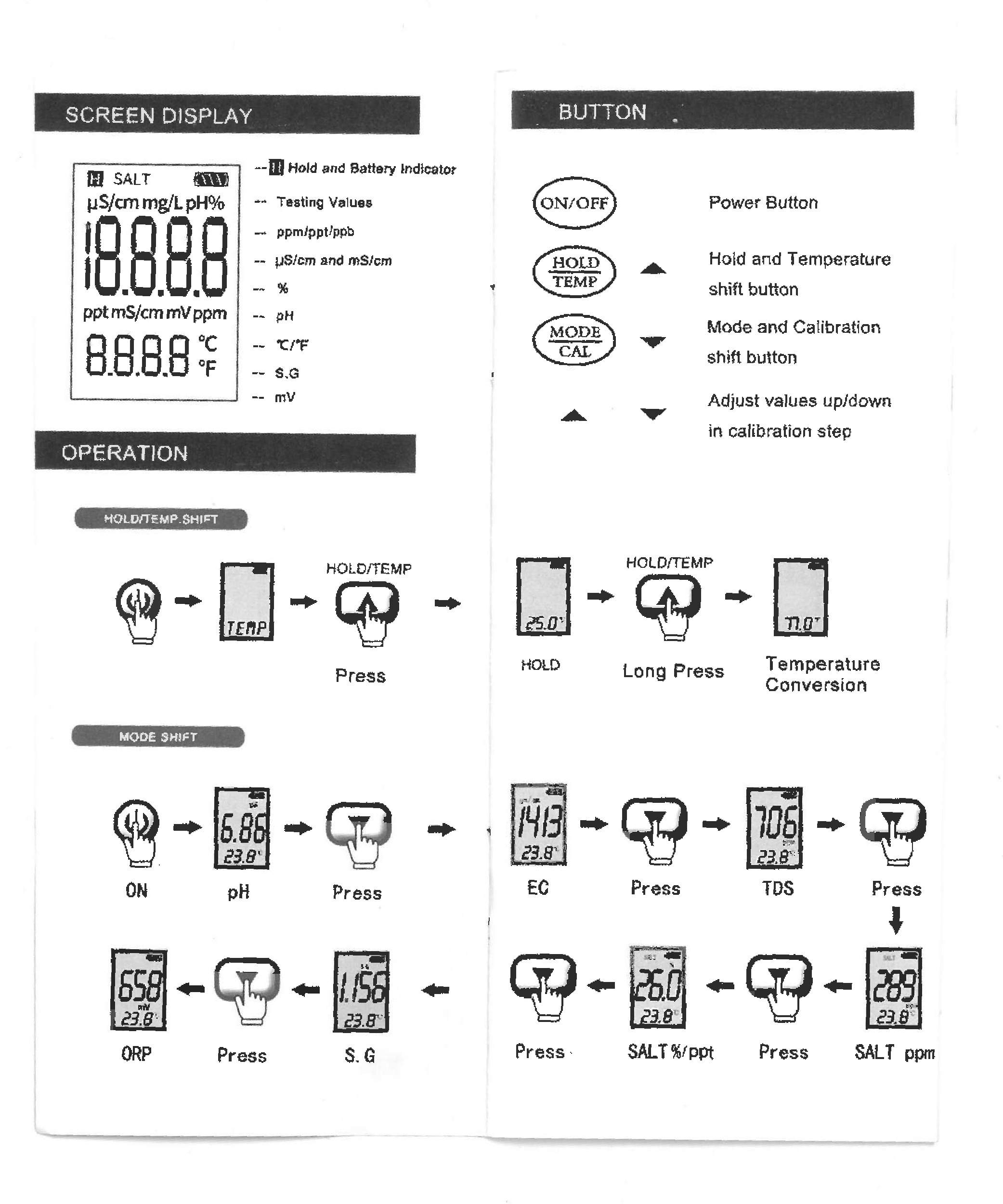

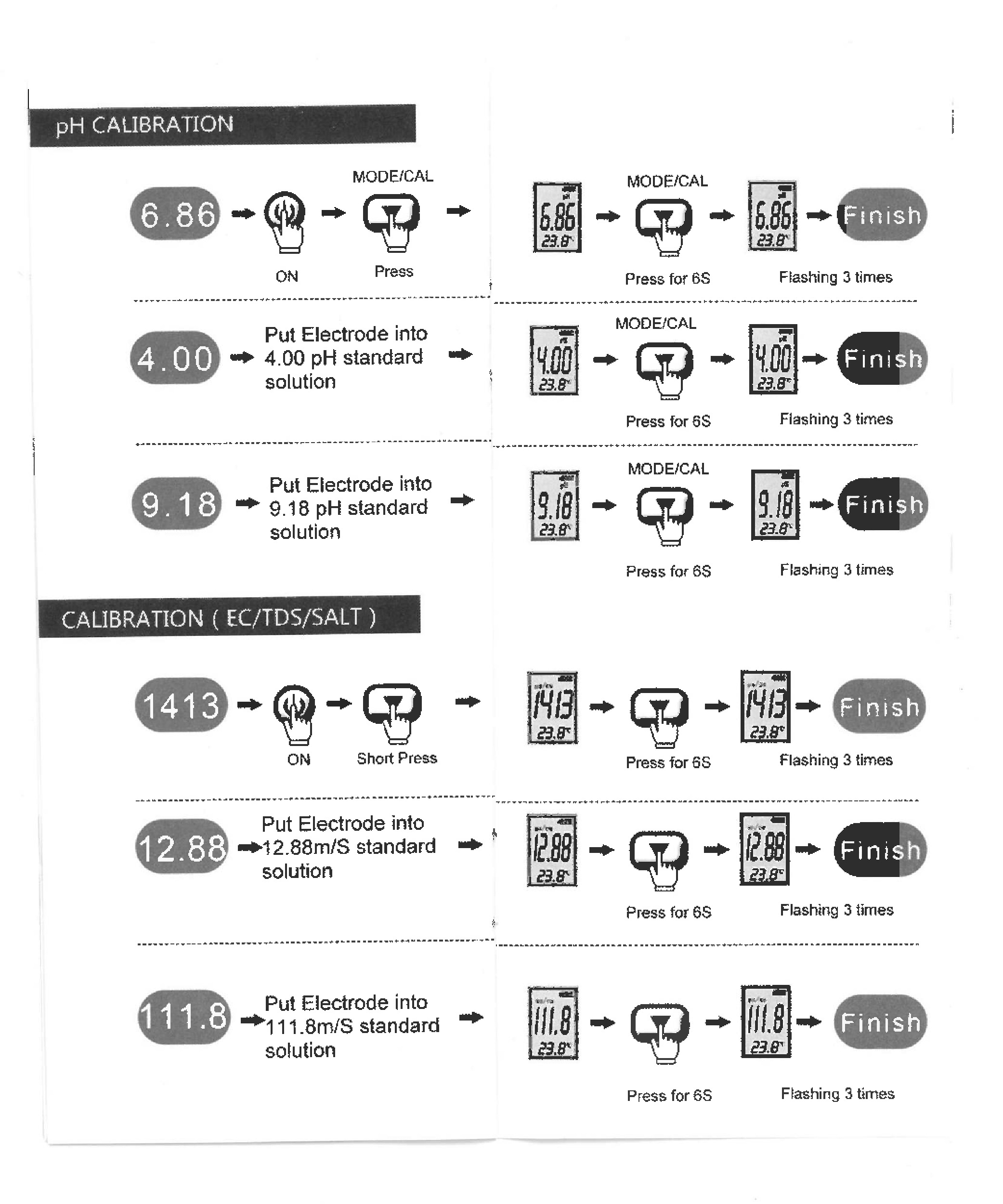
Gemini 3.5 flash
Your 7-in-1 water quality test pen works by using its 5 distinct physical probes to measure different electrical, electrochemical, and thermal properties of your water. It then uses internal mathematical formulas to convert these raw signals into 7 actionable readings: pH, conductivity (EC), Total Dissolved Solids (TDS), salinity, specific gravity (S.G.), oxidation-reduction potential (ORP), and temperature.
Here is a breakdown of exactly how each probe and parameter works.
🔬 The Probe Layout & What They Do
Your pen features two distinct types of sensors that interact with the water:
2 Glass Bulbs: One is a thin-walled pH glass electrode. The other is a sealed bulb housing the reference electrode system.
3 Metal Rods: Two of these rods act as the electrical conductivity (EC) electrodes. The third rod is a combination platinum ORP electrode and a temperature sensor.
⚡ Sensor-by-Sensor Working Mechanism
[ Water Sample ]│├──► Glass Bulbs ───► H+ Ion Exchange ────────► pH Reading│├──► Metal Rods 1&2 ► AC Voltage Resistance ──► EC ──► (TDS / Salinity / S.G.)│└──► Metal Rod 3 ───► Electron Exchange ──────► ORP Reading(with Temp) ───► Resistance Change ──────► Temperature & ATC
1. The Glass Bulbs: Measuring pH
The Science: The main glass bulb is made of a specialized, ion-sensitive glass.
The Process: When submerged, hydrogen ions H+ in the water interact with the outside of the glass bulb, creating a tiny electrical charge.
The Calculation: The second glass bulb provides a stable reference point [ this may not be true for the 7-in-one pen as the pH probe may be a “modern” combination electrode that come with a stable reference electrode already inbuilt ]. The pen measures the voltage difference between the two bulbs and converts this millivolt (mV) signal into a pH reading between 0 and 14.
2. Two Metal Rods: Measuring EC, TDS, Salinity, and S.G.
These two rods handle four different readings using a single physical measurement:
Electrical Conductivity (EC): The pen passes a tiny alternating current (AC) between these two metal rods. Marine water contains dissolved salts (like Na+ and Cl- that carry this current. Higher ion concentration means lower resistance, resulting in a higher EC reading.
Total Dissolved Solids (TDS): The pen multiplies the EC value by a standard conversion factor to estimate the total weight of dissolved solids in parts per million (ppm).
Salinity: Because the salts in seawater are highly predictable, the pen uses a built-in mathematical algorithm to convert the EC value directly into a salinity reading (usually in parts per thousand, ppt, or percentage %).
Specific Gravity (S.G.): Specific gravity measures water density compared to pure water. The pen calculates this by cross-referencing the calculated salinity with the real-time water temperature.
3. The Third Metal Rod: Measuring ORP and Temperature
Oxidation-Reduction Potential (ORP): This rod is typically tipped with a noble metal like platinum. It does not generate a current; instead, it acts as a passive scout to see how easily electrons are being traded in the water. If the water has high sanitizing/oxidizing power, it pulls electrons from the metal, generating a positive millivolt (mV) reading.
Temperature & ATC: Tucked inside this metal rod is a tiny thermistor. Its electrical resistance changes predictably with temperature. The pen uses this data for Automatic Temperature Compensation (ATC). This is crucial because pH and conductivity change drastically based on how hot or cold the water is; ATC mathematically corrects the other 6 readings to ensure accuracy.
✅ Summary of Measurements
Your 5 probes map to your 7 readings through this internal processing logic:
Physical Sensor Used |
Primary Measurement |
Secondary Derived Readings (Via Internal Formulas) |
|---|---|---|
Glass Bulbs (2) |
Potential Difference ($mV$) |
pH |
Metal Rods 1 & 2 |
Electrical Conductivity (EC) |
TDS, Salinity, Specific Gravity (S.G.) |
Metal Rod 3 |
Electron Exchange ($mV$) |
ORP |
Internal Thermistor |
Thermal Resistance |
Temperature (and drives ATC calibration) |
To help you get the most accurate readings out of this pen, let me know:
Are you using this primarily for a saltwater reef aquarium, marine biology, or pool maintenance?
-
Do you need instructions on how to calibrate the pH and EC modes using calibration powders/fluids?
the instrument is to be used to acquire data from a autocatalytic reaction ( the reaction of pyrite (FeS₂, fool's gold) and its metastable precursor mackinawite (FeS), both of which are stable in oxygen-free environments but highly reactive once exposed to air and water).
Using this instrument to monitor an autocatalytic pyrite-mackinawite oxidation reaction is an excellent choice. This specific chemical system will cause rapid, dramatic shifts across almost all 7 parameters.
Because you are dealing with iron sulfides FeS and FeS2 reacting with oxygen and water, the pen's sensors will capture the transition from a highly reduced, neutral/alkaline state to a highly oxidized, strongly acidic state.
Here is how the chemistry of your reaction will physically trigger each of the 5 probes, and how to interpret the data.
🧪 The Chemistry Happening at Your Probes
When oxygen-free mackinawite (FeS) and pyrite (FeS2) are exposed to air and water, they oxidize.

As the reaction progresses, it produces ferrous iron (Fe++), sulfate (SO4--), and hydrogen ions (H+). The Fe++ further oxidizes to Fe+++, which aggressively attacks remaining pyrite, making the reaction autocatalytic (speeding itself up).
📊 How the 5 Probes Will Respond in Real Time
1. The Glass Bulbs (pH Parameter)
The Response: Your pH reading will drop severely.
The Mechanism: The oxidation of pyrite releases massive amounts of free hydrogen ions (H+). These ions pack onto the exterior of the primary glass bulb. The voltage difference between the two glass bulbs will spike, indicating a shift from a near-neutral baseline down into highly acidic territory (potentially pH 2 or lower).
Autocatalytic Indicator: You will see the pH drop slowly at first, followed by a sudden, steep downward curve as the autocatalytic cycle kicks in.
2. Metal Rods 1 & 2 (EC, TDS, Salinity, S.G.)
The Response: Electrical Conductivity (EC) and TDS will skyrocket.
The Mechanism: Initially, insoluble FeS and FeS2 solids do not conduct electricity. As they oxidize, they dissolve into highly mobile ions: Fe++, Fe+++, SO4--, and H+. The two metal rods will easily pass an alternating current through these new ions.
Interpretation Warning: The pen will translate this high conductivity into Salinity and Specific Gravity (S.G.). In this context, ignore the literal terms "salinity" and "S.G." Your pen assumes the ions are sodium and chloride (Na+ and Cl-) from seawater. You are actually measuring Acid Mine Drainage (AMD) ion generation. Use the raw EC (μS/cm or mS/cm) data for your scientific logging, as it directly correlates to the mass of iron sulfide dissolved.
3. Metal Rod 3 (ORP & Temperature)
Oxidation-Reduction Potential (ORP): Your ORP will volt upward (from negative/low to highly positive). In the initial oxygen-free state, the water is highly reducing (negative mV reading due to dissolved sulfides). As oxygen enters and ferric iron (Fe+++) accumulates, the solution becomes fiercely oxidizing. The platinum tip on the third rod will experience a massive pull for electrons, pushing your ORP reading high into positive millivolts (400 mVt o +800 mV). This is your clearest indicator of the reaction's kinetic tipping point.
Temperature: This reaction is exothermic (releases heat). The thermistor inside the third rod will register a temperature spike. Monitoring this is critical because the pen’s Automatic Temperature Compensation (ATC) will be working overtime to correct your pH and EC data as the fluid heats itself up.
⚠️ Crucial Practical Advice for This Experiment
Iron & Sulfur Fouling: Iron sulfides and oxides (like rust/goethite) are notorious for precipitating directly onto sensor surfaces. A film of iron oxide on the glass pH bulb or the metal EC rods will "blind" the pen, causing sluggish or inaccurate data. Action: Between runs (or if readings stall), clean the probes using a weak acid solution (like 0.1M HCl or white vinegar) to dissolve iron scale, followed by a rinse with deionized water.
ORP Stabilization Time: Platinum ORP electrodes can take several minutes to stabilize in iron-rich solutions. If you are doing continuous logging, ensure the pen stays completely submerged and the fluid is gently stirred so ions don't stagnate around the metal rods.
Log the Raw Units: For publication or formal analysis, ignore the pen's built-in marine conversions. Record pH, EC (not Salinity), ORP (mV), and Temperature (C).