Om redox fra (fantastiske) GeoGirl YouTube (https://www.youtube.com/watch?v=lJGqnZOHG5w)
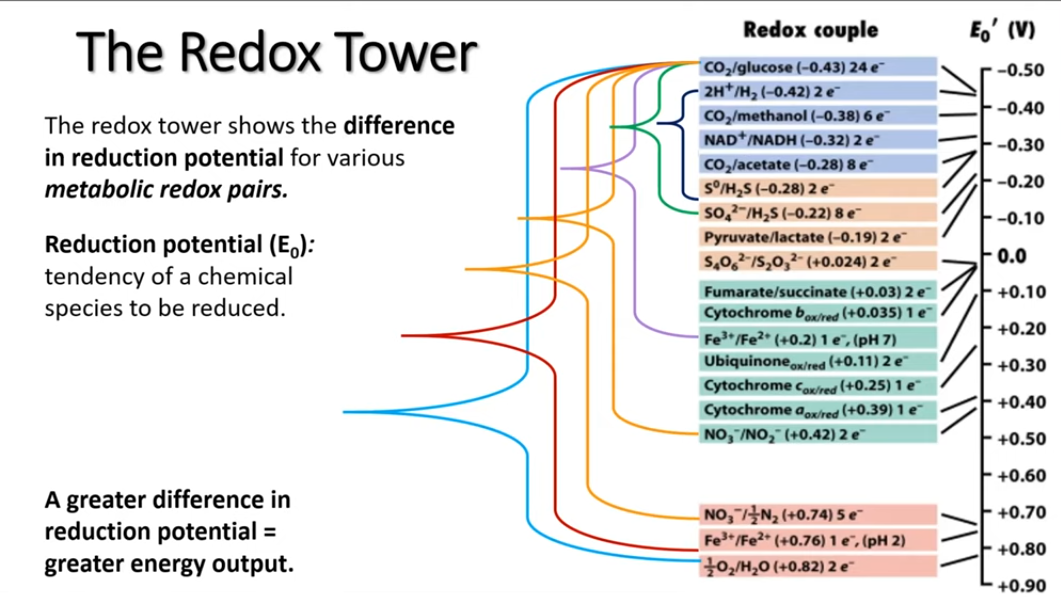


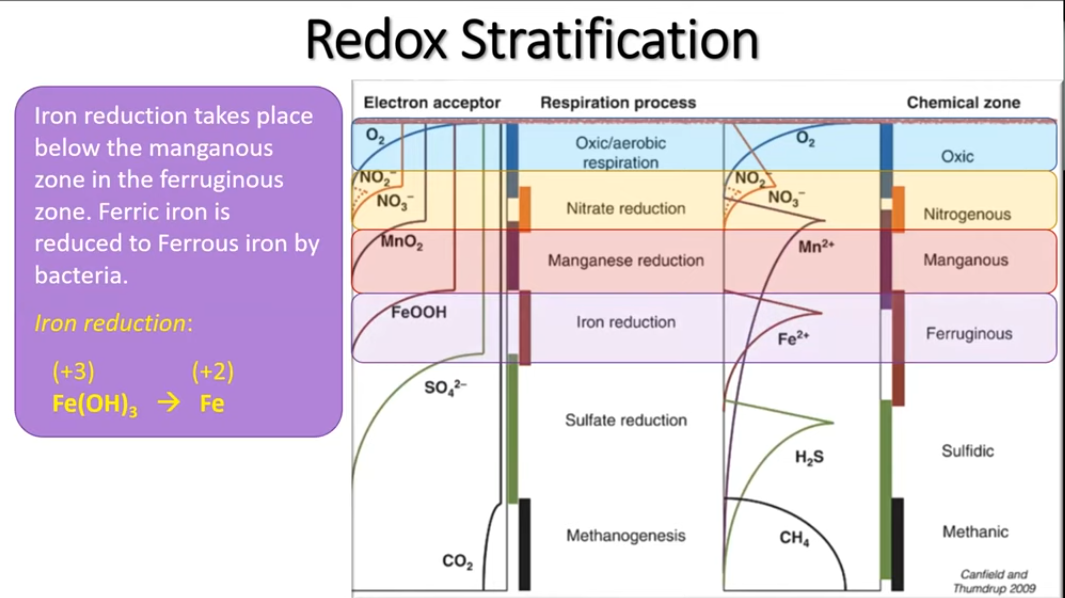

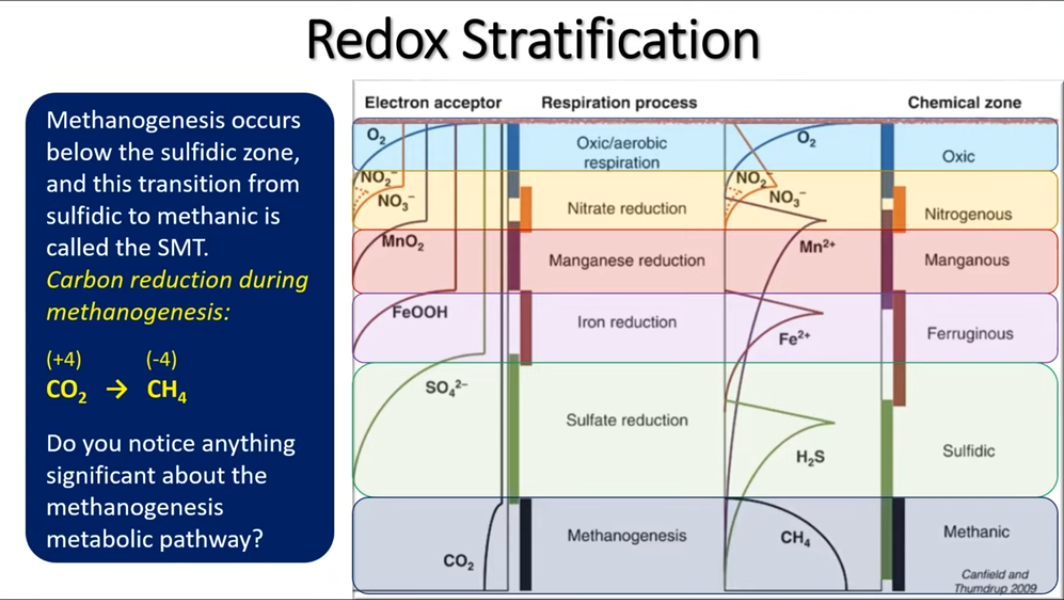
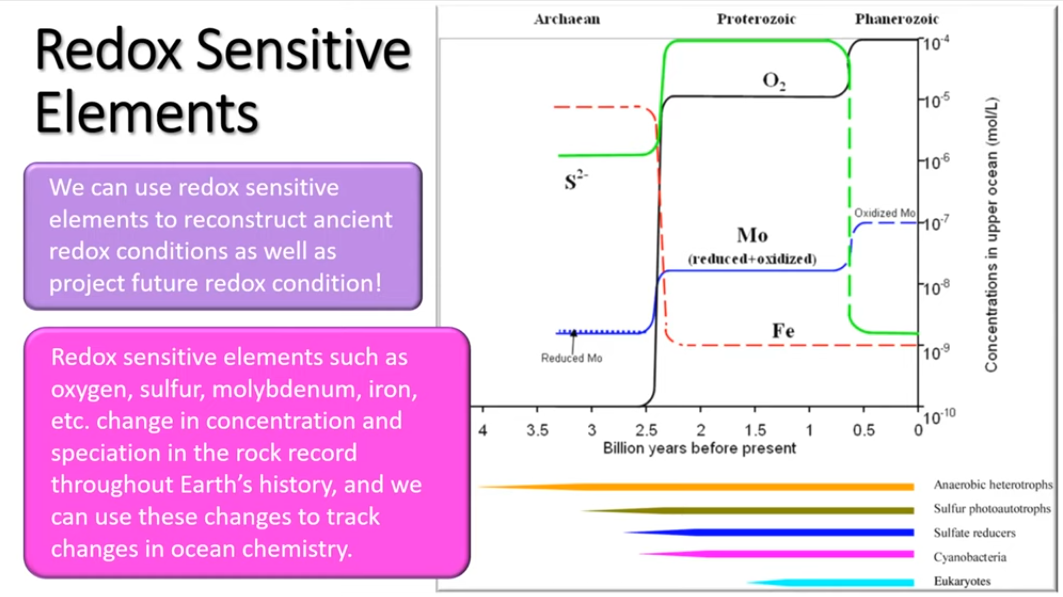
Which redox reactions are thermodynamically favored in seawater when extra Fe and Mn are present, and how this compares with the normal seawater redox chemistry.
The best way to see this is by looking at electrochemical (standard reduction) series relevant to seawater conditions.
1. Core electrochemical series for seawater (simplified)
Seawater is:
• Oxygenated (O2 dissolved)
• Slightly basic (pH ≈ 8)
• Rich in Cl−, Na+, Mg2+, Ca2+
A simplified reduction series (from strong oxidizing agents at the top to strong reducing agents at the bottom) is:
Half-reaction (reduction) E� (V)
O2 + 2H2O + 4e− → 4OH− +0.40
Fe3+ + e− → Fe2+ +0.77
MnO2(s) + 2H2O + 2e− → Mn2+ + 4OH− +0.40
Fe2+ + 2e− → Fe(s) −0.44
Mn2+ + 2e− → Mn(s) −1.18
This already tells us a lot about what will happen.
2. Iron chemistry in oxygenated seawater
Volcanic ash can add Fe2+ and Fe3+ to seawater.
Key comparison:
O2/OH− (E∘≈+0.40 V)
vs.
Fe3+/Fe2+ (E∘=+0.77 V)
Because oxygen is present, Fe2+ is easily oxidized to Fe3+:
4Fe2++O2+2H2O→4Fe3++4OH−
Then, at seawater pH:
• Fe3+ hydrolyzes and precipitates as Fe(OH)3(s)
Result: Iron tends to end up as solid iron(III) hydroxides or oxides.
3. Manganese chemistry in oxygenated seawater
Volcanic ash can add Mn2+.
Relevant half-reaction:
MnO2(s)+2H2O+2e−→Mn2++4OH− (E∘≈+0.40 V)
This potential is very similar to oxygen reduction, meaning:
• Mn2+ can be oxidized by O2
• But much more slowly than iron
Overall reaction:
2Mn2++O2+2H2O→2MnO2(s)+4H+
Result: Manganese often persists longer in solution than iron, but eventually forms MnO2(s) coatings on particles.
4. Combined electrochemical series relevant to volcanic ash input
Putting the key couples together:Oxidizing strength (top → bottom):
O2 / OH−
Fe3+ / Fe2+
MnO2(s) / Mn2+
Fe2+ / Fe(s)
Mn2+ / Mn(s)
From this series you can predict:
• O2 oxidizes Fe2+ → Fe3+ (fast)
• O2 oxidizes Mn2+ → MnO2 (slow)
• Fe3+ can oxidize Mn2+ under some conditions
• Metallic Fe or Mn would never survive in seawater
5. Environmental implication
In ash-enriched seawater:
• Iron precipitates quickly and is often scavenged by particles
• Manganese remains dissolved longer
• Redox chemistry strongly controls nutrient availability and trace metal cycling
This is why volcanic ash inputs can temporarily fertilize the ocean but also rapidly remove metals from solution.
One-sentence takeaway: Electrochemical series show that in oxygenated seawater, iron is oxidized and removed faster than manganese, because the Fe3+/Fe2+ couple lies above the MnO2/Mn2+ couple
in redox potential.
In low-oxygen conditions, the chemistry of metals like iron (Fe) and manganese (Mn) behaves quite differently. Without dissolved oxygen to act as a strong oxidizing agent, the redox reactions
involving these metals shift, and their behavior in the seawater changes significantly.
1. Key Differences in Low-Oxygen (Anoxic) Conditions
In anoxic environments, such as deep ocean waters or sediment pore waters affected by volcanic ash, oxygen is either absent or present in very low amounts. This alters the electrochemical dynamics:
• Oxygen cannot oxidize iron (Fe2+ → Fe3+) or manganese (Mn2+ → MnO2) as efficiently.
• Instead, other compounds or reactions come into play to either reduce iron and manganese or to prevent their oxidation.
2. Electrochemical Series Under Low-Oxygen Conditions
Let’s look at how the electrochemical potentials shift when oxygen is limited.
• In oxygenated seawater, we saw that the potential for oxygen reduction (O2 + 4e− → 4OH−) is +0.40 V.
• In low-oxygen conditions, we focus more on reduction reactions that happen without oxygen.
Now, let’s take a look at the reduction half-reactions for Fe and Mn again, in the context of anoxic conditions:
Half-reaction (reduction) E� (V)
Fe3+ + e− → Fe2+ +0.77
MnO2(s) + 2H2O + 2e− → Mn2+ + 4OH− +0.40
Fe2+ + 2e− → Fe(s) −0.44
Mn2+ + 2e− → Mn(s) −1.18
3. Iron Behavior in Anoxic Conditions
In anoxic environments, iron (Fe) behaves differently than in oxygenated seawater. Specifically:
• Fe3+ (ferric iron) is a strong oxidizing agent in oxygenated water, but in low-oxygen conditions, it can easily be reduced to Fe2+ (ferrous iron) by organic material or by other
reducing agents present in the water or sediments.
• Since Fe2+ (Fe2+ → Fe) is much more stable in anoxic conditions (as shown by the negative E� of −0.44 V), iron tends to precipitate as Fe2+ or stay in solution as Fe2+, especially in the
absence of oxygen.
This leads to:
1. Dissolution of iron in reduced forms (Fe2+) in anoxic waters.
2. Precipitation of iron as iron minerals like FeS or FeCO3 in the presence of sulfide (from microbial activity) or carbonate ions.
Iron does not precipitate as Fe(OH)3 (which happens in oxygenated conditions), because there’s no oxygen to oxidize Fe2+ to Fe3+.
4. Manganese Behavior in Anoxic Conditions
Manganese, like iron, is also affected by the absence of oxygen, but its behavior is slightly different:
• In oxygenated seawater, Mn2+ would typically be oxidized to MnO2 (manganese dioxide), which is insoluble and precipitates.
• However, in anoxic conditions, Mn2+ is stable and doesn't form MnO2 (which requires oxygen). Instead, Mn2+ remains in solution and can be readily reduced further into solid
Mn(s) (metallic manganese) by microbial activity or other reducing agents in the sediment or water.
Because Mn2+/Mn(s) has a more negative potential (−1.18 V), it’s easy for Mn2+ to remain in its reduced form Mn2+ in anoxic conditions. Over time, Mn2+ can accumulate in solution, or it can form
MnS (manganese sulfide) if there are sulfides present (common in anoxic environments).
So in low-oxygen conditions, manganese does not precipitate as MnO2 and remains much more soluble than iron.
5. Key Processes in Anoxic Conditions
In anoxic (low-oxygen) seawater or sediment conditions, several processes are at play:
• Iron (Fe2+) can remain dissolved in water, while Fe3+ remains reduced.[ here the AI may be wrong - OIL mean Oxidation Is Loss of an electron ]
• Manganese (Mn2+) also remains in solution but does not form MnO2 (manganese dioxide), as it does in oxygenated conditions.
These two metals have different redox potentials that allow them to behave differently in these environments:
• Fe2+ may precipitate as sulfides (FeS) or carbonates (FeCO3).
• Mn2+ will often remain in solution or form MnS.
The redox series in these conditions tells us that Fe2+ is more stable in anoxic conditions, while Mn2+ can stay dissolved for a longer period, especially if there are microbial processes that further reduce
Mn.
6. Summary of Low-Oxygen Behavior
Metal In Low-Oxygen Conditions
Iron (Fe) Fe2+ stays in solution or forms iron sulfides/carbonates. No Fe3+ precipitates as Fe(OH)3.
Manganese (Mn) Mn2+ remains soluble in anoxic conditions. It does not precipitate as MnO2, but can form MnS in the presence of sulfides.
7. Environmental Implications
• Iron is often sequestered in sulfide minerals like FeS in anoxic environments.• Manganese, with a more negative reduction potential, can stay in solution longer, contributing to the cycling of nutrients in the water column, and it can precipitate as manganese sulfide (MnS) if sulfides are present.
In anoxic conditions, both metals can act as important redox mediators and play a role in the cycling of carbon, nitrogen, and other nutrients in marine environments.
One-Sentence Summary: In low-oxygen conditions, iron remains as soluble Fe2+ and precipitates as iron sulfides, while manganese stays in solution as Mn2+ or forms MnS, rather than precipitating as MnO2 like it does in oxygenated conditions.